A website that fits the way law firms actually work.
Practice areas, attorneys, publications, case studies, clients - flawlessly connected. Hire once. Every profile, recognition, and case updates automatically. Built for India’s full-service firms and boutiques.

Your firm's website
was built for a
moment in time.
Then partners moved,
practices evolved,
and it never kept up.
Every law firm we've worked with has the same story. The site was launched with a developer or an agency. It looked great on day one. Three years and twelve hires later, the firm pages contradict each other, the leadership directory is wrong, and the practice areas list partners who left in 2023.
It's not a bandwidth problem. It's a model problem.
Hire a partner. Edit five places. Forget two.
Her profile must appear on her practice area pages, the leadership directory, the recognitions wall, and any cases she's led. Five edits, in five places, for one new hire.
Partners leave. Their names don't.
Profiles get hidden, but their names still appear on case studies, publications, and "team" mentions buried in older posts. Search engines find them. Prospects do too.
Two decades of insight, disconnected online.
Insights and op-eds go up as flat blog posts. They aren't connected to authors, practice areas, or topics — so the firm's body of work never compounds into one.
Same programs.
Same numbers.
Two universes.
 Drag to compare
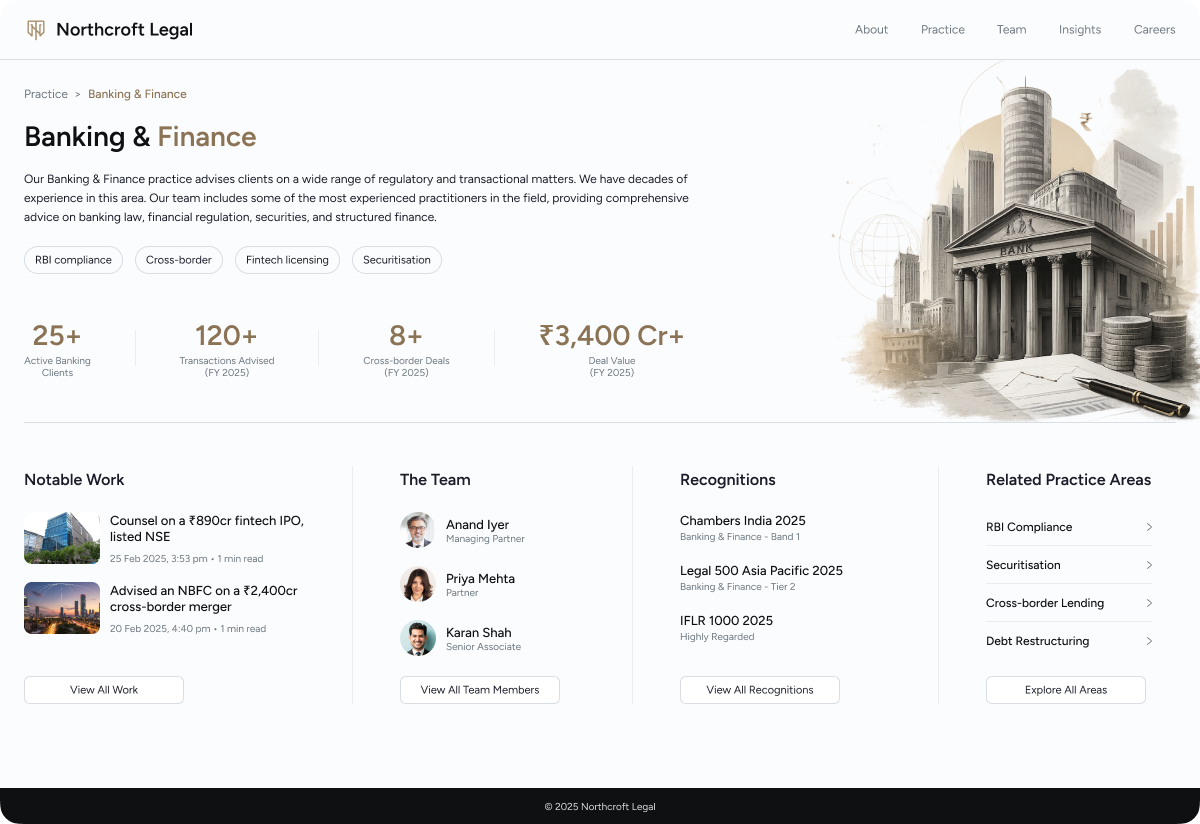
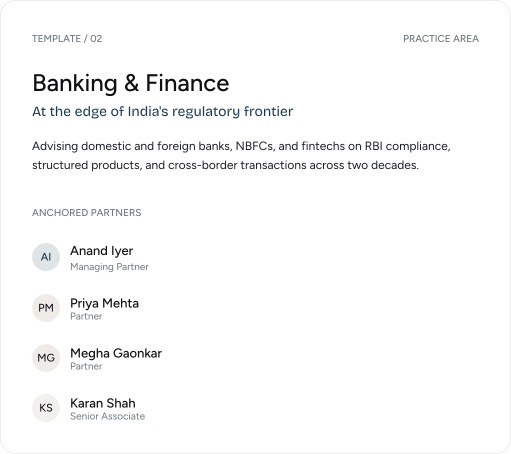
Drag the handle to see the same Banking & Finance practice page rendered two ways: a typical WordPress build cobbled together over three years, and the same content on Apex's relational model. The left has flat text, broken links, and SEO keyword stuffing. The right is a constellation of connected entities — every block on the page is computed from underlying data that stays in sync.
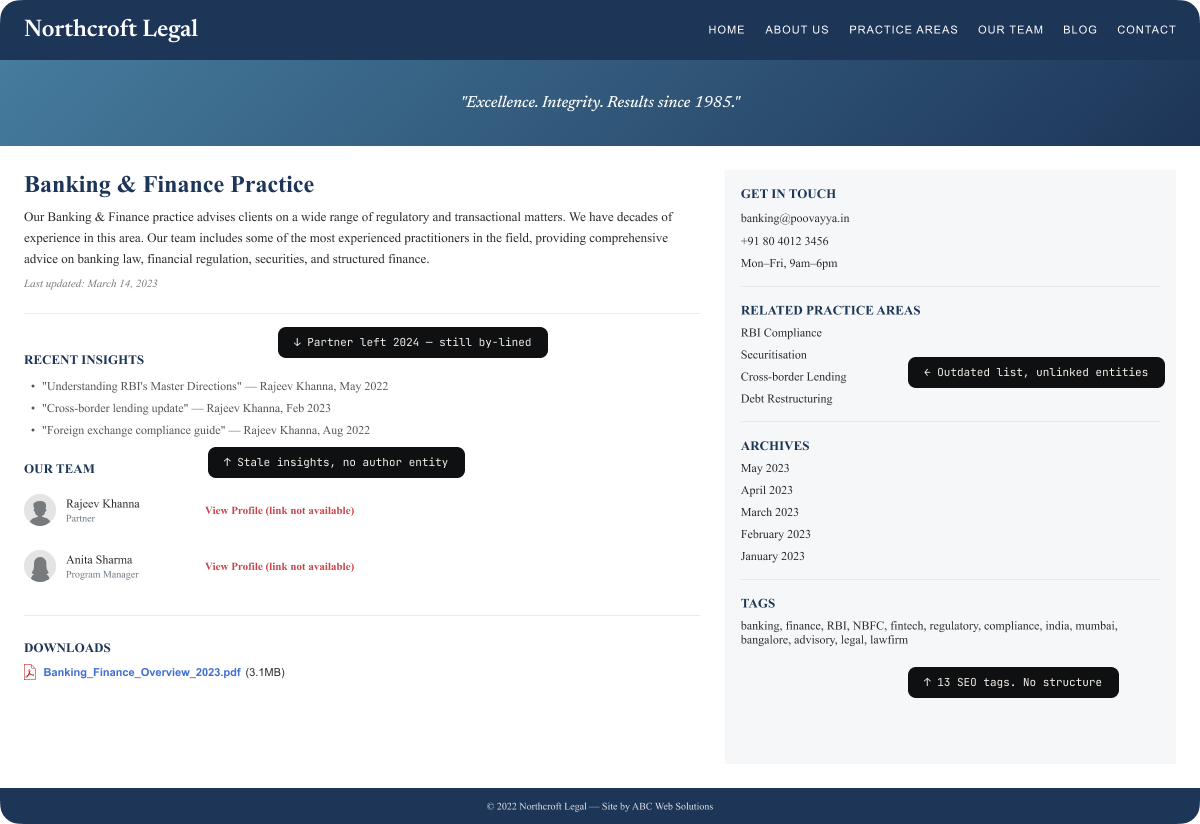
The lead partner left a year ago. His insights still by-line his name. Banking is a tag, not an entity, so the firm has no team page for it, no related publications, no case study index. The 13 SEO tags are an admission of defeat: when content has no structure, you stuff keywords.
Every block on the right is computed from connected entities — partners pulled from Attorney, insights filtered by topic, cases by practice, recognitions by attorney. Edit Priya's profile once: her name updates here, on her profile, on every byline, on every case she's led, on every recognition she's earned. Mark Rajeev gets alumni; he disappears from every surface at once.
Click an entity.
See what it knows
about your firm.
Apex ships with a content model designed for the way law firms organise themselves: practice areas, attorneys, publications, case studies, industries, and clients. Every entity has the right fields. Every relationship is bidirectional. You don't have to design any of it.
Click any entity to see its connections
Attorney
A person at the firm. Bio, role, qualifications, recognitions, practice areas, and publications live in one place. Update once, and every profile, mention, and page stays automatically in sync.
Four legal templates.
Designed with intent,
not generated.
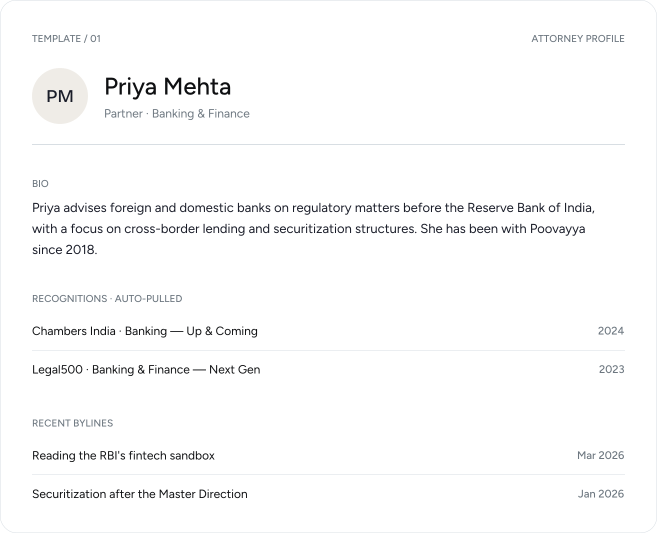
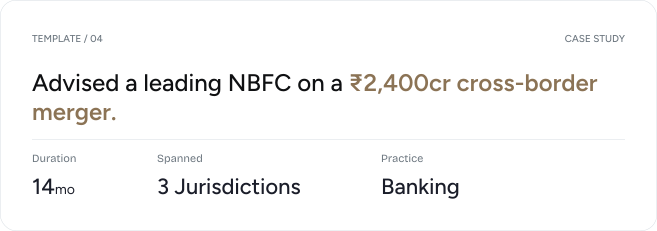
Apex ships with a content model designed for the way law firms organise themselves: practice areas, attorneys, publications, case studies, industries served, recognitions, and clients. Every entity has the right fields. Every relationship is bidirectional. You don't have to design any of it.

A delivery process
tuned to how
partners
actually work.
A delivery process designed around how partners and marketing leads at law firms actually work. Confidentiality is built in. Reviews are scheduled around real diaries. Bar-council compliance checks are baked into the launch checklist.
Intake & data gather
Compose & refine
Partner review
Launch & handover
A 90-minute call with the marketing lead and one partner. We capture the firm, your practices, your team, bios, bylines, awards across one email or shared drive.
A designer composes each surface from the legal content library. Practice areas and partner bios are refined with our editor — not auto-generated.
Practice-by-practice review with the relevant partners. Edits go in via the editorial model — so Priya's bio once, every page updates.
Bar-council compliance check, launch, DNS handover. Marketing lead trained on the relational way of working — and the Content Co-pilot for ongoing publishing.
Northcroft Legal* moved 40 years of practice onto Apex's relational model. *name changed
A Bengaluru-headquartered full-service firm with offices in three cities, four practice groups, 80+ attorneys, and two decades of insight content that had silently rotted on a self-managed WordPress install. Our first legal build, and the one that taught us how to model law firms.
184
Insights, op-eds, and notes carried over and re-connected to authors and practices.
80+
Attorneys remodelled with bios, bylines, recognitions, and practice links — once.
0
Stale partner entries on launch day.
Six months in: still zero.
1
hr/wkMarketing lead's ongoing maintenance time, down from a day.
"We'd put off the rebuild for three years because every quote came back as nine months and a six-figure budget. With Apex, the data model already understood our firm. Our marketing lead now spends more time correcting my bio than maintaining the site."
Apex was Northcroft's first relational-model build. The team migrated in five weeks: one week of intake, three weeks of composition, one week of partner review and launch.
The firm's marketing lead — who had inherited the WordPress install — now publishes new insights and bylines without wiring or breaking a single layout.
The questions managing partners actually ask us on the call.
A short list of common questions, gathered to make our conversations easier. If yours isn’t here, please raise it and we’ll be happy to add it.
Every Apex layer also goes through a Rule 36 compliance pass before launch. We don't do "client testimonials" the way a consumer site does, we don't claim "best in class," and the case study templates are built so you can showcase work without naming clients or making comparative statements. We've launched a number of full-service firms; nothing has ever bounced from BCI review.